Darwin’s Paradox Review: A Clever Puzzle-Platformer with Limbo-Like Charm
Darwin’s Paradox Review: A Charming 2D Puzzle-Platformer About an Octopus Trying to Get Home
Darwin’s Paradox is a short, colorful, and surprisingly clever 2D puzzle-platformer that turns a simple idea into a memorable indie adventure. Instead of putting players in control of a traditional hero, the game stars Darwin, a small octopus who simply wants to return to the ocean. Unfortunately for him, his trip home happens during a full-scale alien invasion of Earth.
That premise gives Darwin’s Paradox an instantly charming identity. This is not a dark, disturbing puzzle-platformer in the style of Limbo or Inside. It uses some similar side-scrolling puzzle design ideas, but the tone is much lighter. Rather than relying on horror, dread, or unsettling imagery, Darwin’s Paradox leans into cartoon comedy, expressive animation, bright environments, and a playful retro sci-fi atmosphere.
The result is a pleasant and well-paced adventure that makes strong use of its roughly six-hour runtime. It does not overstay its welcome, and it constantly introduces new situations that keep the journey moving. While some trial-and-error moments can be frustrating, Darwin’s Paradox succeeds because of its personality, smart use of octopus abilities, and steady variety.
A Funny Premise With a Clever Perspective
The best part of Darwin’s Paradox is the way it frames its story. Darwin is not a chosen one, a soldier, or a brave resistance fighter. He is just an octopus who has ended up far from home. While players can clearly see that Earth is being invaded by aliens, Darwin does not fully understand the larger situation around him.
That disconnect is what makes the comedy work. The player sees the danger and absurdity of the alien invasion, while Darwin only reacts to the immediate problems in front of him. He is not trying to save the world. He is trying to avoid being eaten, crushed, captured, or trapped long enough to get back to the ocean.
This gives the game a fun silent-comedy quality. Darwin feels less like a traditional video game protagonist and more like a cartoon character who accidentally stumbles through a disaster. The world around him is full of danger, but his limited perspective makes the story feel playful instead of grim.
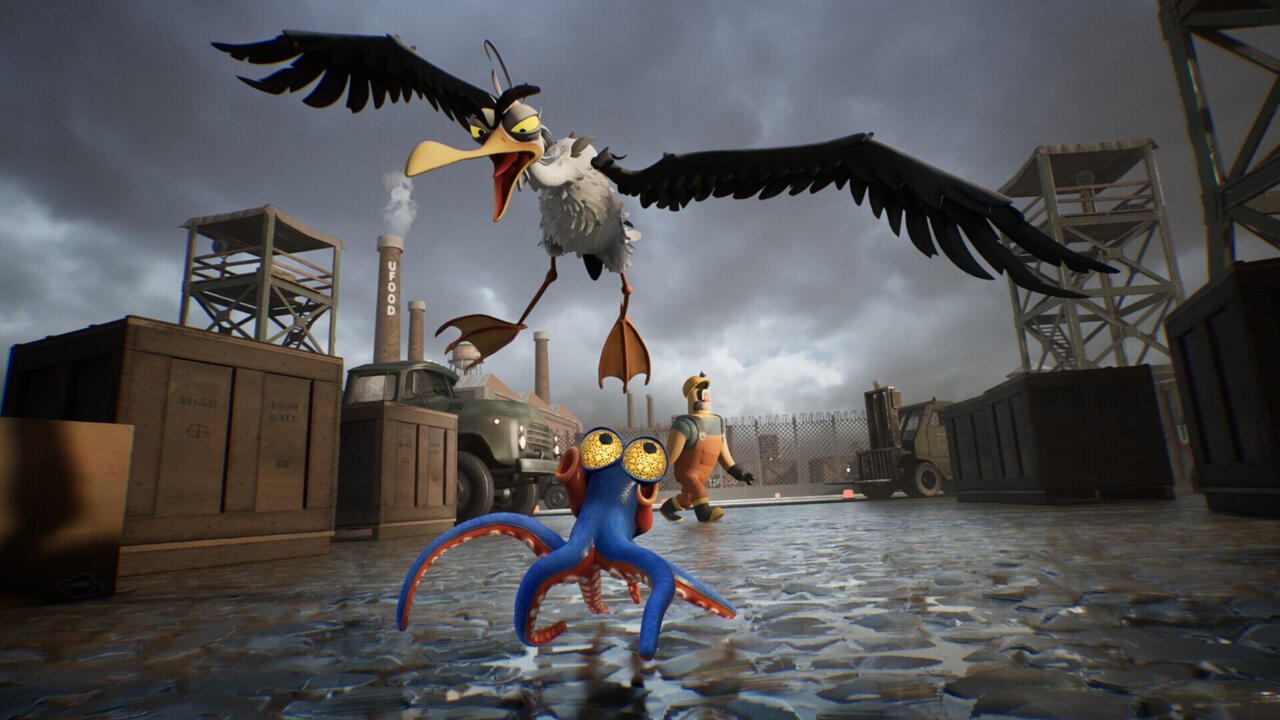
The aliens also help sell that tone. Their designs have a campy 1950s flying saucer energy, and their plans are often presented with exaggerated visual humor. Their corporate-style disguises and food-related jokes add another layer of silliness to the setting. It is the kind of game where background details can quietly land a joke before you even realize it.
Octopus Abilities Make Platforming Feel Fresh
Darwin’s Paradox works because Darwin’s abilities are directly tied to real octopus behavior. Instead of giving him random video game powers, the developers build his moveset around traits people already associate with octopuses.
Darwin can stick to walls using his suckers, shoot ink to distract or escape predators, camouflage himself to hide from enemies, and move freely underwater. These abilities give the platforming a strong identity. You are not just playing as a generic mascot character with a jump button. You are controlling a small, vulnerable sea creature using natural survival tools in dangerous environments.
The difference between land and water movement is especially effective. On land, Darwin can still climb, crawl, and solve puzzles, but he feels slightly out of place. Underwater, movement becomes smoother and more natural, giving players full freedom to swim in any direction. That contrast reinforces the entire premise: Darwin belongs in the ocean, and everything on land feels more hostile and awkward.
This design choice makes the game more immersive. The controls communicate Darwin’s situation without needing heavy dialogue or exposition.
Combat-Free Gameplay Built Around Avoidance
Darwin is not a fighter, and Darwin’s Paradox is better for it. The game does not ask players to defeat enemies through combat. Instead, every tool is designed around survival, stealth, and environmental interaction.
One section may ask players to sneak past alien patrols by using camouflage at the right moment. Another may involve shooting ink at a switch to control machinery. Elsewhere, Darwin may need to climb walls, avoid moving hazards, or swim past predators using ink clouds as cover.
This keeps the gameplay varied without becoming complicated. The game regularly rotates between stealth, platforming, environmental puzzles, timing challenges, and underwater navigation. Because the adventure is relatively short, these ideas do not have time to become stale.
The lack of combat also makes Darwin feel more vulnerable. He survives through cleverness and movement, not force. That vulnerability is important because it makes even simple hazards feel threatening. A human hero might fight back against aliens, but Darwin has to slip away, hide, or improvise.
Smart Puzzle Design With Plenty of Variety
The puzzles in Darwin’s Paradox are generally simple, but they are well matched to the game’s tone and pacing. Most challenges are built around using Darwin’s abilities in clear, practical ways. Players may need to interact with machines, avoid security systems, time movement past enemies, or combine traversal skills to reach a new area.
The game’s strongest design choice is that it rarely relies on one type of challenge for too long. A stealth section may be followed by an underwater escape. A machinery puzzle may lead into a climbing sequence. A dangerous predator encounter may shift into a visual gag or a new environmental hazard.
This variety helps the game feel dense despite its short length. Rather than stretching a small number of ideas across too many hours, Darwin’s Paradox keeps introducing new twists and locations. That makes it easy to stay engaged from beginning to end.
A Colorful World With Retro Sci-Fi Personality
Visually, Darwin’s Paradox is one of its biggest strengths. The game plays on a 2D plane, but the backgrounds have a strong sense of depth. The environments feel layered, and the action in the foreground often connects nicely with the world behind it.
The art direction blends colorful cartoon design with retro science fiction. Darwin’s natural marine-world charm contrasts with the factories, labs, sewers, and alien technology he moves through. This contrast gives the game a distinct look: part aquatic adventure, part alien-invasion comedy, and part classic animated short.
Darwin himself is extremely expressive. Even without speaking, he communicates fear, confusion, curiosity, and determination through body language. His animations are small but effective, helping players connect with him as more than just a puzzle-solving character.
The same is true for the aliens. They are goofy, exaggerated, and easy to read visually. Their designs make the world feel dangerous but not oppressive. The game wants players to laugh at the absurdity of the situation, even when Darwin is moments away from being crushed or eaten.
Trial-and-Error Can Be Frustrating
The main downside of Darwin’s Paradox is its reliance on learning through failure. The game has generous checkpoints, so death rarely sends players far back. However, some traps are difficult to understand until they kill you once.
This creates a pattern where players encounter a hazard, die, restart nearby, then try again with new knowledge. In small doses, this is manageable. But when multiple trial-and-error moments appear close together, it can become annoying. It is especially frustrating when you complete one difficult section only to immediately die to a new trap you could not reasonably predict.
The game softens this issue with its cartoon tone. Many deaths are animated in a cute or funny way, which makes failure less harsh. Still, repetition can occasionally interrupt the otherwise smooth pacing.
Fortunately, this problem does not ruin the experience. The checkpoints are forgiving, and most obstacles can be solved quickly once you understand them. But players who dislike trial-and-error puzzle design should be aware that it is part of the game’s structure.
A Short Adventure That Does Not Waste Time
Darwin’s Paradox is not a long game, but that works in its favor. At around six hours, it delivers a complete adventure without dragging out its mechanics. Many indie puzzle-platformers struggle when they stretch a simple idea too far, but Darwin’s Paradox avoids that problem by keeping the pace brisk.
Each major area introduces new hazards, new visual ideas, or new ways to use Darwin’s abilities. The game feels carefully edited, with very little filler. This makes it a strong choice for players who want a focused weekend game rather than a long open-ended experience.
The short runtime also helps the humor stay fresh. The alien-invasion premise, cartoon deaths, and octopus-based platforming remain charming because the game does not overuse them.
Final Verdict: A Charming Indie Platformer Worth Playing
Darwin’s Paradox is a charming and creative 2D puzzle-platformer with a strong sense of identity. Its octopus protagonist is more than a cute gimmick; Darwin’s abilities shape the movement, puzzles, stealth, and overall feel of the game. The result is an adventure that feels natural, playful, and distinct.
The game’s colorful art style, expressive animation, retro sci-fi humor, and combat-free design help it stand apart from darker puzzle-platformers. It may share some genre DNA with games like Limbo and Inside, but it has a much warmer and funnier personality.
Some trial-and-error traps can be frustrating, and a few sections may require repeating actions until the timing is right. However, the generous checkpoints and lighthearted presentation make these issues easier to accept.
For players who enjoy indie puzzle-platformers, cartoon-style adventures, clever traversal abilities, and short games with lots of variety, Darwin’s Paradox is easy to recommend. It is a strong debut for both Darwin and developer ZDT Studio, and it leaves the door open for more adventures with this unlikely little octopus hero.
Darwin’s Paradox FAQ
What kind of game is Darwin’s Paradox?
Darwin’s Paradox is a 2D puzzle-platformer focused on stealth, environmental puzzles, traversal, and survival. Players control a small octopus trying to return to the ocean during an alien invasion.
Is Darwin’s Paradox a combat game?
No. Darwin does not fight enemies directly. The gameplay is built around avoiding danger, hiding, solving puzzles, climbing, swimming, and using ink or camouflage to survive.
How long is Darwin’s Paradox?
The game takes roughly six hours to complete, depending on how quickly players solve puzzles and navigate platforming challenges.
What makes Darwin’s Paradox unique?
The game stands out because its mechanics are based on real octopus traits, including wall-clinging, ink clouds, camouflage, and strong underwater movement.
Is Darwin’s Paradox worth playing?
Yes. Darwin’s Paradox is worth playing for fans of indie puzzle-platformers, charming cartoon visuals, light stealth mechanics, and short but varied adventures.