Vampire Crawlers Review: Retro Chaos with Razor-Sharp Pixel Precision
Vampire Crawlers Review: A Deckbuilding Dungeon Crawler That Keeps the Vampire Survivors Magic Alive
Vampire Crawlers takes one of the most addictive indie formulas of the last few years and reshapes it into something familiar, strange, and surprisingly hard to put down. Instead of simply copying Vampire Survivors, this spin-off moves the action into a first-person, grid-based dungeon crawler built around deckbuilding, turn-based combat, and roguelike progression.
That shift in perspective could have easily made the game feel disconnected from its source material. Instead, Vampire Crawlers manages to preserve the tone, style, characters, weapons, and chaotic energy that made Vampire Survivors so popular. It is clearly a different game, but it still feels like it belongs in the same universe.
The result is a clever and highly replayable roguelike that trades real-time survival for planning, card combos, and strategic dungeon movement. It may not stay equally challenging from beginning to end, but its upgrade systems, relics, deck interactions, and explosive late-game builds make it easy to fall into the familiar “just one more run” loop.
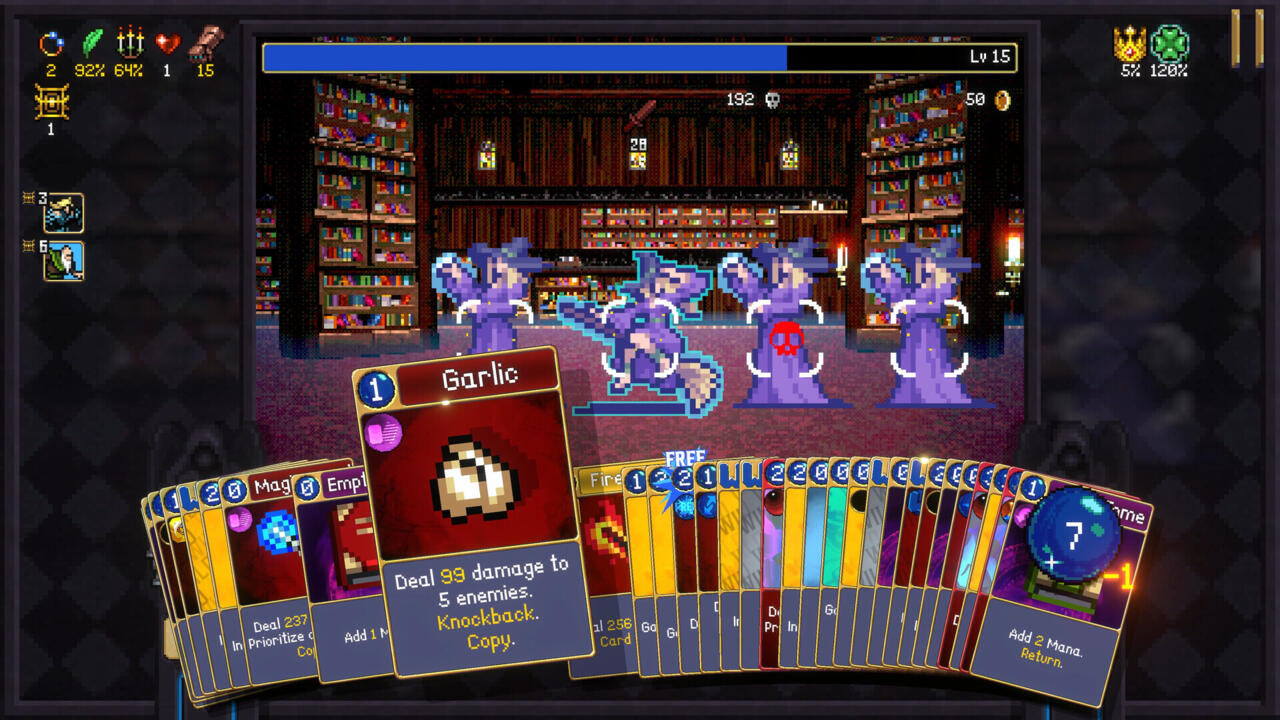
A New Perspective on the Vampire Survivors Formula
The most noticeable difference in Vampire Crawlers is the shift from top-down survival action to first-person dungeon exploration. Vampire Survivors was built around constant movement, automatic attacks, and overwhelming enemy waves. Vampire Crawlers slows that structure down and turns it into a more deliberate experience.
Players move through dungeon floors on a grid, choosing routes, approaching enemy groups, and deciding when to take risks. Battles are turn-based, and attacks are performed by playing cards from a deck. It is a major mechanical change, but the game still captures the absurd escalation and monster-clearing satisfaction that fans expect.
The transition works because Vampire Crawlers does not abandon the identity of Vampire Survivors. Familiar weapons and items return as cards, including options like Knife, Whip, Cross, Spinach, and Pummarola. Damage cards, healing cards, buffs, and evolutions all help connect the new format to the original game’s progression style.
Even with the new dungeon-crawling structure, the game still understands the appeal of becoming ridiculously powerful. Early runs require careful planning, but later runs often become wild displays of overpowered card chains, upgraded stats, and screen-clearing attacks.
Deckbuilding Makes Combat More Strategic
Combat is the heart of Vampire Crawlers. Instead of directly attacking enemies in real time, players use cards that cost mana to play. Most cards require between zero and three mana, and managing those costs is essential to surviving tough encounters.
The most interesting mechanic is the combo system. Playing cards in numerical order increases the power of later cards in the chain. This encourages players to think carefully about sequencing rather than simply playing the strongest card available. A well-built combo can turn a normal attack into a devastating blow or make a defensive buff far more valuable.
This system gives Vampire Crawlers more depth than it may first appear to have. It is not just about collecting powerful cards. It is about understanding how those cards work together, when to spend mana, when to save resources, and how to turn an average hand into a winning turn.
Damage cards are satisfying, especially when a combo turns them into massive enemy-clearing attacks. However, some of the most rewarding moments come from using combos to improve buffs, increase max health, strengthen stats, or create long-term advantages during a run. When a build starts working properly, it creates the same kind of snowball effect that made Vampire Survivors so addictive.
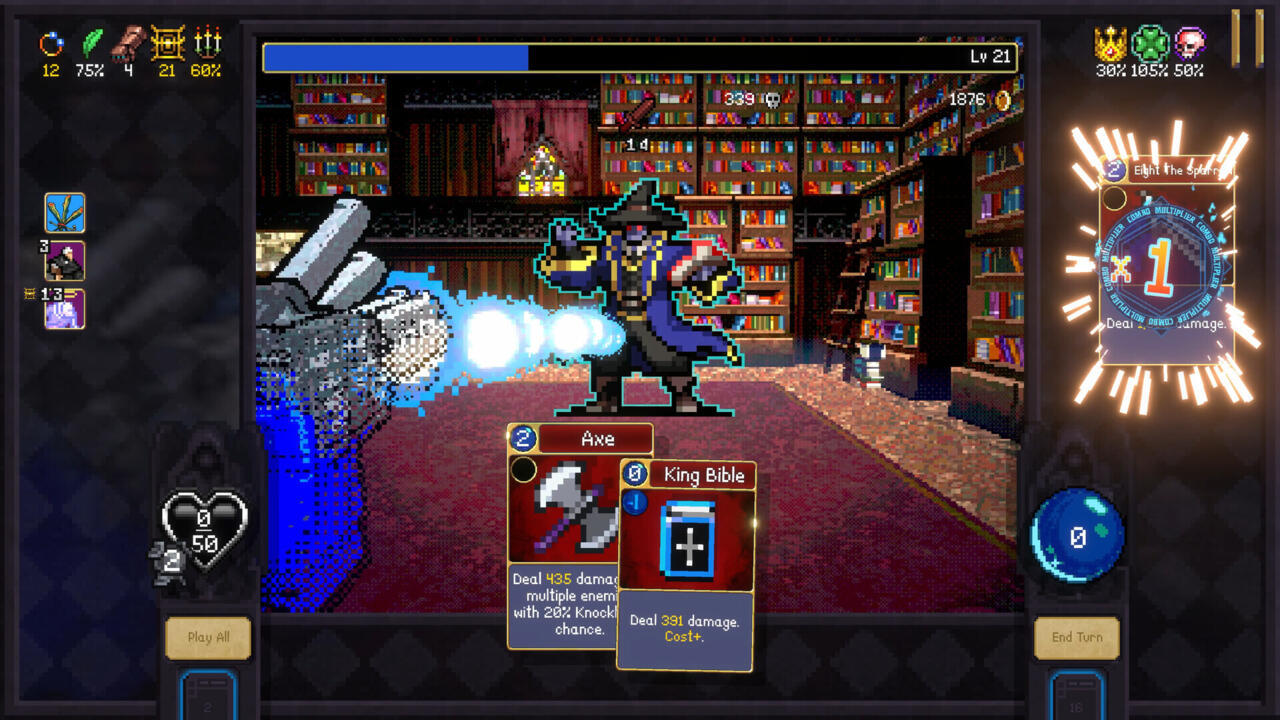
Crawlers Add Personality and Build Variety
Vampire Crawlers also introduces playable companions known as Crawlers. Instead of directly controlling a traditional character, players bring Crawlers along as part of their loadout. Each Crawler has unique starting weapons and passive bonuses, but they also appear as cards that can be played during battle for temporary effects.
These effects can include damage boosts, experience bonuses, or other advantages that shape how a run develops. Eventually, players can bring up to three Crawlers into a dungeon, which opens the door for more strategic combinations.
This system works well because it adds personality without overcomplicating the core gameplay. Choosing the right Crawlers before a run can influence your deck direction, early-game strength, and long-term strategy. Since card rewards are partly random, your starting choices matter. A good Crawler setup can help reduce bad luck and give your build a clearer identity from the beginning.
There is still randomness involved, and not every run will give you the perfect cards. However, Vampire Crawlers is rarely so punishing that one bad reward ruins everything. In many cases, clever combo usage and smart navigation can carry a messy deck further than expected.

Dungeon Exploration Adds Risk and Reward
The dungeon structure gives Vampire Crawlers a slower and more tactical rhythm than Vampire Survivors. Each floor contains enemies, loot opportunities, and tougher encounters. Deciding where to go first can make a major difference, especially during the early hours.
Taking on a stronger enemy too soon can leave you underprepared and low on health. On the other hand, beating a difficult encounter early can reward you with the exact card or upgrade needed to dominate the rest of the floor. That risk-reward balance is one of the game’s strongest early features.
New cards are earned by leveling up or finding special loot points throughout the dungeon. This encourages players to explore efficiently and think ahead. The best route is not always the safest one, and the safest route is not always the most rewarding.
During the first half of the game, this strategic navigation creates a strong sense of tension. Every fight matters, and every decision can affect the rest of the run. As players unlock more upgrades, however, earlier dungeons become much easier. Once you gain enough permanent power, returning to older areas can feel more like farming than survival.
Progression and Relics Keep the Game Fresh
Like Vampire Survivors, Vampire Crawlers is built around gradual power growth. Players can unlock permanent stat upgrades that improve damage, health, mana, and other core attributes. These upgrades make each run feel more manageable and give the game a strong sense of forward momentum.
However, the more interesting progression comes from Relics. Relics are major unlocks found later in the campaign, and they can introduce new mechanics that change how players approach deckbuilding and exploration.
Some Relics affect how cards interact with gems. Gems can be added to cards to provide passive or active bonuses, and the right gem setup can dramatically improve a build. Later systems allow players to influence which gems appear, giving more control over the direction of a run.
This is where Vampire Crawlers starts to reveal its long-term depth. At first, more options seem like an obvious advantage. But over time, players may realize that limiting the pool of possible rewards can be even stronger. By increasing the odds of finding the best gems, it becomes easier to create powerful and consistent builds.
That kind of discovery is one of the game’s best qualities. Vampire Crawlers starts as a simple dungeon-crawling card game, then slowly opens into a playground of synergies, upgrades, and increasingly broken combinations.
The Late Game Is About Controlled Chaos
Eventually, Vampire Crawlers reaches the same kind of power fantasy that defined Vampire Survivors. Once enough upgrades, Relics, Crawlers, cards, and gems are unlocked, players can build decks that overwhelm enemies with very little resistance.
For some games, that would be a problem. Here, it feels intentional. Vampire Crawlers understands that part of the fun is becoming absurdly strong. The challenge is not only surviving; it is figuring out how far you can push the system.
Late-game runs can become almost automatic, especially once a deck is strong enough to chain cards efficiently and wipe out enemies with ease. The game even supports that feeling through fast card play and systems that let players lean into the chaos. What begins as a tense dungeon crawl eventually becomes a satisfying test of how much destruction your build can produce.
This may reduce the difficulty, especially when revisiting older dungeons, but it also creates a rewarding payoff. After spending hours learning the mechanics and unlocking key systems, it feels good to crush enemies that once seemed threatening.
Vampire Crawlers Is Addictive Despite Some Repetition
Vampire Crawlers does lose some of its early strategic pressure as players become stronger. Dungeon layouts are randomized, but the general flow becomes easier to understand after several runs. Once permanent upgrades stack high enough, older areas can become predictable.
Still, the game remains compelling because its deckbuilding systems continue to encourage experimentation. Trying different Crawler combinations, testing new cards, adjusting gem setups, and chasing stronger synergies give players plenty of reasons to start another run.
The game works because it knows what type of experience it wants to deliver. It is not trying to be a brutally punishing roguelike where every mistake ends a run. Instead, it is a progression-driven power fantasy where smart decisions eventually lead to ridiculous builds and satisfying destruction.
Final Verdict: A Smart Spin-Off With Real Staying Power
Vampire Crawlers is a successful reinvention of the Vampire Survivors formula. By turning the action into a first-person deckbuilding dungeon crawler, it creates a fresh experience while keeping the personality, weapons, upgrades, and chaotic power scaling that fans already love.
The combat system is simple to understand but rewarding to master. The combo mechanic adds real strategy, Crawlers provide useful build variety, and Relics introduce enough new systems to keep the game interesting across many hours. While the difficulty curve softens over time, the late-game power fantasy feels like part of the design rather than a flaw.
Players looking for a traditional action game may need time to adjust to the slower, turn-based structure. But anyone who enjoys deckbuilding roguelikes, dungeon crawlers, or Vampire Survivors-style progression will likely find a lot to love here.
Vampire Crawlers proves that the Vampire Survivors universe can work outside its original format. It is familiar without feeling lazy, different without losing its identity, and addictive enough to make one more run turn into several more hours.
Vampire Crawlers FAQ
What type of game is Vampire Crawlers?
Vampire Crawlers is a first-person, grid-based dungeon crawler with roguelike progression, deckbuilding mechanics, and turn-based battles.
Is Vampire Crawlers connected to Vampire Survivors?
Yes. Vampire Crawlers is a spin-off that uses familiar characters, items, weapons, visual style, and progression ideas from Vampire Survivors, but it changes the gameplay format significantly.
How does combat work in Vampire Crawlers?
Combat is turn-based and uses cards. Players spend mana to play attack, support, healing, and buff cards. Playing cards in numerical order creates combos that strengthen later cards.
Is Vampire Crawlers difficult?
The early game can be tense because players must carefully manage health, card rewards, and dungeon routes. As upgrades and Relics are unlocked, the game becomes more focused on powerful builds and large-scale enemy destruction.
Who should play Vampire Crawlers?
Vampire Crawlers is a strong choice for fans of Vampire Survivors, deckbuilding roguelikes, dungeon crawlers, and games built around long-term progression and overpowered builds.